The full story
The challenge
Three warehouses. Three spreadsheets. Zero confidence in any of them.
NorthStock Fulfilment had expanded quickly. What started as a single site with a manageable stock list had grown into a multi-location operation with thousands of product lines moving in and out each week.
The spreadsheets had grown with it. Each location had its own way of recording stock. Updates were manual, often delayed, and occasionally contradictory. When a customer needed to know whether an item was available, the answer depended on who you asked and when they had last updated their sheet.
Stock errors showed up in two ways. Either a pick team pulled a quantity that did not match the system, or a replenishment order arrived for something that was already well-stocked at a different location. Both were common. Both were expensive.
The operations manager had built workarounds over time. Weekly reconciliation meetings. Spot checks before large orders. Phone calls between sites to confirm what the system could not. It kept things moving, but it was never a real solution.
The solution
We built a system designed around the physical reality of how warehouse teams work, not around what looks good in a software demo.
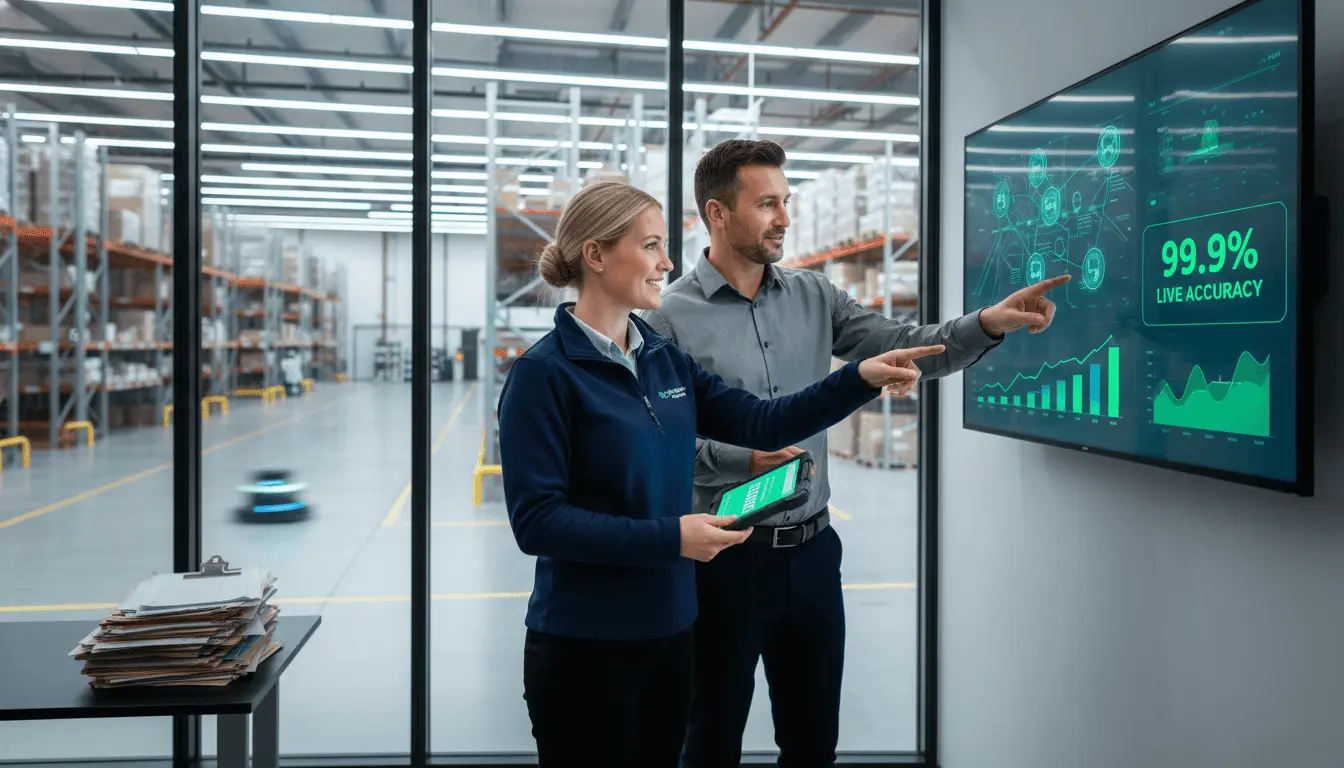
At the core is a web-based stock management platform that holds a single source of truth across all three locations. Stock levels update in real time. Every movement, whether it is a receipt, a pick, a transfer, or a return, is logged against the correct location, product, and timestamp.
For the warehouse floor, we built a mobile app. Scan a QR code on a shelf or product, confirm the action on screen, and the system updates immediately. The teams needed no lengthy training. The app is direct enough that most staff were comfortable within their first shift.
We printed QR codes for existing shelving and product labels as part of the rollout. The team did not need to replace any infrastructure. The system fitted around what was already there.
Reporting came built in. The operations manager can pull a stock level report for any location at any point. Low-stock alerts run automatically. When a transfer between sites is needed, the system logs it and both locations reflect the change straight away.
The result
Within the first full month, stock errors dropped by 85%. The weekly reconciliation meeting that previously ran for two hours was cut to twenty minutes, and eventually stopped altogether.
The operations manager put it simply. For the first time, they could make decisions based on actual numbers rather than best estimates.
Pick accuracy improved because the app removed ambiguity from the process. Replenishment orders became more predictable because the underlying data was finally clean.
The three warehouses still run independently day to day. The system connects them without making the team feel like they work in the same building.
If your stock data is only as good as the last person who remembered to update it, we can give you something more reliable.
What changed
After go-live, the shift showed up in the week first. Then it showed up in the numbers. Here is what that looked like on the ground.
from the first full month after go-live
across all three warehouse locations
previously lost to manual stock counts each week
How we approached this