The full story
The challenge
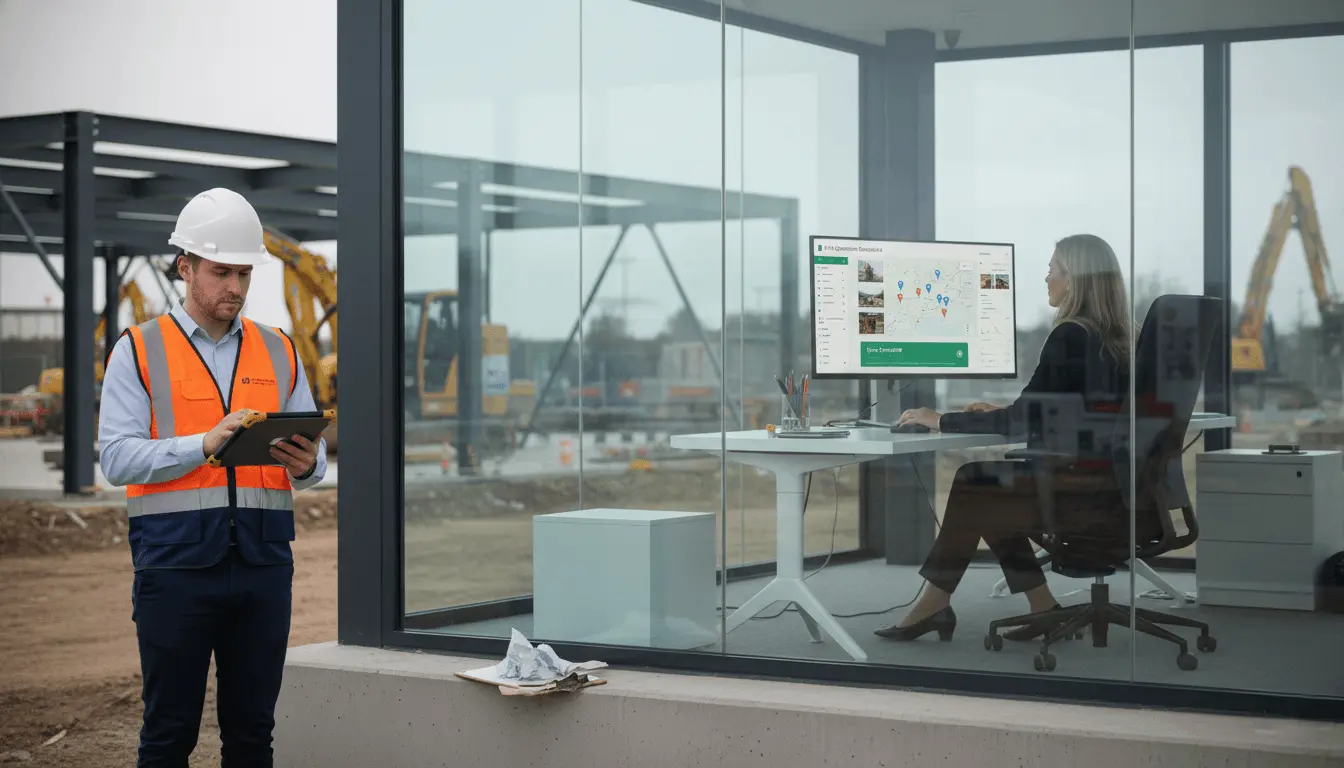
Every job ended the same way. A form on a clipboard, a photo on someone’s personal phone, and a promise that the paperwork would land on the office desk before Friday.
Sometimes it did. Sometimes it did not.
Aurora Building Solutions had grown fast. Their ground team was professional and reliable. The process around them had not kept up. Site staff were filling in questionnaires and job sheets by hand, often in difficult conditions, and passing that information back to the office through a mix of email, WhatsApp, and physical paper.
The office team had no clear picture of where jobs stood at any given time. Following up meant phone calls. Chasing incomplete forms meant delays. Storing and protecting sensitive client data in filing cabinets and shared email inboxes was becoming a genuine compliance concern.
There was no shortage of effort from the team. The problem was that the tools they were using were not built for how the business actually ran.
The solution
We started by sitting down with both sides of the operation. The ground team told us what made forms hard to fill in on site. The office team told us what information they actually needed to move a job forward. Those two conversations shaped everything that followed.
For the field team, we built a native Android app. It works on the devices they already carry. Forms are structured to match the job types they handle, with logical sections, dropdown selections, and the ability to attach photos directly to a submission. If a site has poor signal, submissions queue and send when connectivity returns.
For the office, we built a web-based management system. Jobs move through defined stages. Managers can review submissions, flag issues, add notes, and mark jobs as complete. Every stage is logged. Nothing falls through the gaps because the system owns the handoff, not an email thread.
Security was not an afterthought. Every submission is encrypted at rest using AES-256 and in transit using TLS 1.3. Access is fully role-based, so a ground team member sees only what they need for their work while a director has full visibility. We built GDPR compliance into the architecture from the start rather than adding it later.
We ran the rollout in stages. The ground team had the app on their devices before we asked them to trust it. We went through real forms with them, resolved the questions that came up in training, and confirmed the app fitted the way they worked before the old process was retired.
The result
On the first Monday after go-live, forms started arriving the same day they were completed. The office team stopped chasing.
Managers could see exactly where every job stood without picking up the phone. Incomplete submissions were flagged automatically. Data that once lived in email attachments and filing cabinets was now stored securely, searchable, and protected in line with GDPR requirements.
Aurora Building Solutions did not change how they work. They got a system that finally matched it.
If your team is still bridging the gap between site and office with paper and goodwill, that gap has a cost. We can help you close it.
What changed
After go-live, the shift showed up in the week first. Then it showed up in the numbers. Here is what that looked like on the ground.
replacing paper delays of up to three days
with AES-256 and TLS 1.3 throughout
from day one after launch
How we approached this